
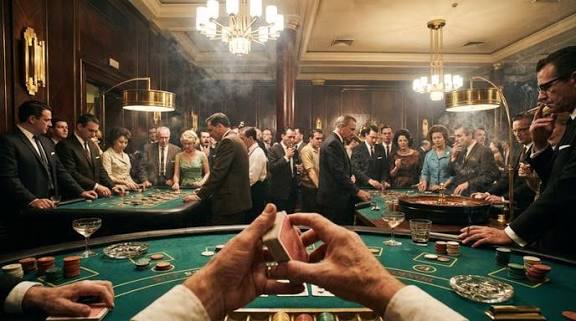
In the late 1960s, Las Vegas was becoming one of America’s most exciting entertainment destinations. Its casinos attracted tourists, celebrities, and wealthy gamblers, but the industry still carried a reputation for organized-crime connections and informal business relationships.
Then Howard Hughes arrived.
Hughes was already famous as an aviation pioneer, film producer, businessman, and one of the wealthiest people in America. His arrival in Las Vegas was unusual even by the city’s standards. He stayed inside a hotel for an extended period, avoided public appearances, and began acquiring casinos and property on a remarkable scale.
His buying spree did more than make headlines. It helped change perceptions of casino ownership, strengthened the role of large-scale investment, and coincided with legal changes that made it easier for corporations to enter Nevada’s gambling industry.
Who Was Howard Hughes?
Howard Hughes had built a reputation as an ambitious and often unconventional businessman long before he arrived in Nevada. He made money in aviation and film, invested in major companies, and became known for his interest in engineering and ambitious projects.
By the mid-1960s, however, Hughes had become increasingly reclusive. His private life attracted intense public interest, and he often conducted business through trusted representatives rather than appearing personally.
Las Vegas offered an opportunity to invest in real estate, hotels, entertainment, and gambling. The city was growing, tourism was expanding, and casino properties could generate substantial revenue. Hughes saw potential in acquiring established resorts as well as land that might become valuable as the city developed.
His approach differed from that of the traditional casino operator. Rather than relying only on a single hotel or gambling business, Hughes used his financial resources to build a broader portfolio of properties and investments.
The Desert Inn Purchase That Started It All
Hughes arrived in Las Vegas around Thanksgiving in 1966 and checked into the Desert Inn, then one of the city’s prominent luxury casino resorts.
He and his entourage occupied a substantial amount of space in the hotel. According to widely repeated accounts, the Desert Inn’s management eventually wanted the rooms back for other guests, especially during the busy holiday season. Hughes responded by pursuing ownership of the property rather than moving out.
In 1967, he acquired the Desert Inn in a deal commonly reported at approximately $13.2 million, including cash and financing. The purchase gave him a major foothold in the Las Vegas casino business.
The episode became part of Hughes’s local legend. A wealthy guest had arrived in town, stayed largely out of sight, and ended up buying the hotel where he was living. But the purchase was not merely an eccentric response to a room dispute. It became the starting point for a much larger investment strategy.
The Casino Buying Spree
After acquiring the Desert Inn, Hughes began buying additional properties and land around Las Vegas. His casino acquisitions included the Sands, the Frontier, the Castaways, the Silver Slipper, and the Landmark, although the timing and structure of individual deals varied.
He also invested in real estate and other local assets. His purchases gave him an unusually broad presence in the city’s economy and made him one of Nevada’s most important private investors.
The scale of his spending attracted attention because Las Vegas was still associated with a mix of independent operators, family businesses, and investors with organized-crime connections. Hughes represented a different kind of buyer: a nationally recognized billionaire whose wealth came from businesses outside gambling.
His presence did not instantly eliminate criminal influence or make every casino operation transparent. It did, however, offer a powerful public example of a wealthy outsider investing heavily in Nevada’s resort industry.
Why the Corporate Gaming Act Mattered
Hughes’s buying spree coincided with a major shift in Nevada gaming law.
In 1967, Nevada adopted the Corporate Gaming Act, which helped make it easier for publicly traded corporations to own casino businesses without requiring the same individual licensing scrutiny for every shareholder. The details of corporate gaming regulation continued to evolve, but the change helped remove a significant obstacle to broader corporate participation.
This mattered because a large public company could raise money from many investors. Under the right regulatory structure, it could use that capital to acquire properties, construct hotels, expand entertainment facilities, and develop larger resorts.
Hughes became a visible example of how major investment could reshape the casino industry. Other businesspeople and corporations saw that Las Vegas offered opportunities beyond traditional gambling operations.
The new direction would eventually support the rise of larger resort companies and more ambitious hotel developments. Hughes was not solely responsible for that transition, but his presence arrived at a moment when the industry’s ownership structure was changing.
The Failed Stardust Deal
Hughes’s appetite for Las Vegas properties did have limits. One of his most discussed attempted acquisitions involved the Stardust, a major Strip resort with a complicated ownership history.
The deal did not go through. Antitrust concerns and the concentration of casino revenue under Hughes’s growing portfolio became important issues as his local influence expanded.
The failed purchase highlighted a contradiction in Hughes’s strategy. His financial strength could help bring new capital and credibility to Las Vegas, but acquiring too many competing properties could also raise concerns about market power.
Hughes’s growing portfolio had become so significant that federal authorities examined whether his acquisitions threatened competition. The broader lesson was that casino ownership was no longer just a matter of private deals. It was increasingly shaped by gaming regulation, corporate law, and competition policy.
How Hughes Changed Las Vegas’s Image
Hughes’s importance was partly financial and partly symbolic.
His investments helped make casino ownership more acceptable to mainstream business interests. A billionaire known for aviation and film was purchasing major resorts in a city that had long struggled with an image tied to gambling and organized crime.
That did not mean the old problems disappeared. Investigations into organized-crime influence continued, and state regulators still had to address questions about who controlled casino properties and whether operators met licensing requirements.
But Hughes’s investment helped demonstrate that Las Vegas could attract capital from outside the traditional gambling world. Over time, corporate ownership, professional management, and large-scale resort development became increasingly central to the city’s identity.
The transformation also changed the visitor experience. Casinos became part of increasingly elaborate destinations featuring hotel towers, restaurants, shows, convention facilities, and other attractions. The modern resort model had multiple sources of revenue rather than relying exclusively on the gaming floor.
What Happened to Hughes’s Las Vegas Empire?
Hughes did not remain in Las Vegas indefinitely. He left the city in 1970 after several years of largely private living and business activity. His investments continued to shape the local market, but the companies and properties associated with his portfolio experienced further ownership changes.
His time in Nevada was brief compared with the city’s much longer history. Yet his acquisitions came at a turning point, when legal reforms and new investment were helping transform casino ownership.
It is important not to give Hughes sole credit for creating modern Las Vegas. Other developers, including Kirk Kerkorian, played major roles in the growth of large resort hotels. Gaming regulators, public companies, financiers, and tourism operators all helped build the corporate casino era.
Hughes was one of the figures who made that transition visible.
Conclusion
Howard Hughes’s Las Vegas buying spree began with the Desert Inn and expanded into a portfolio of casinos, hotels, and real estate. His wealth and national reputation brought a different kind of investor into a city whose gambling industry was changing rapidly.
The acquisitions coincided with reforms that made corporate casino ownership more practical and helped open the door to larger-scale investment. Hughes did not single-handedly end organized crime’s influence or invent the megaresort, but he played an important role in changing how Las Vegas was financed and perceived.
His legacy is a reminder that the city’s evolution was shaped not only by entertainers and gamblers, but also by investors, regulators, and business decisions made far from the casino floor.
FAQs
1. When did Howard Hughes arrive in Las Vegas?
Hughes arrived around Thanksgiving in 1966 and checked into the Desert Inn.
2. Why did Howard Hughes buy the Desert Inn?
Accounts commonly explain that hotel management wanted the space occupied by Hughes and his entourage back for other guests. Hughes chose to pursue ownership, turning the situation into his first major Las Vegas casino acquisition.
3. Which casinos did Howard Hughes own?
His Las Vegas portfolio included the Desert Inn, Sands, Frontier, Castaways, Silver Slipper, and Landmark, along with other real estate and business interests.
4. What was the Corporate Gaming Act?
Nevada’s 1967 Corporate Gaming Act helped make it easier for public corporations to own casino businesses, supporting wider investment in the gambling industry.
5. Did Howard Hughes end mob control of Las Vegas?
No. His investments helped change the industry’s image and ownership structure, but reducing organized-crime influence took years of federal investigations, regulatory action, legal changes, and ownership transitions.